

Spirituality
In the fall of 2025 Doctor Richard Schwartz provided training with Sounds True about the journey to your sacred self. [1] Reddit group-chatter was that in this course and elsewhere, Dr. Schwartz describes all parts as spirits, with support given to conversations with ancestors. The training is being offered again in 2026.
With my lifelong quest to find a spirituality that can coexist with my natural skepticism, I was intrigued. I find the creator of Internal Family Systems Theory to be a reliable and rational man. His theory is rooted in his clinical practice. So I’m willing to consider what he has to say. Also, I start my course in Jungian Coaching in a little under a month and I’m thinking, “maybe I need clarity on the idea of the self, especially the Jungian and Schwartzian views.”
A Basic Definition
We use the term “self” and its various versions - yourself, myself, itself, ourselves - without much need for a formal definition. We have a felt sense of what it is to be a self. Respecting this felt sense is an important starting place in the discussion.
We frequently use the compound words too -- self-image, self-worth, self-criticism, and self-worth. Self seems, self-evident. But there are similar words that muddy the water a bit. These include soul, ego, mind, consciousness, intellect, intelligence, personality, and of course psyche.
I will need to know what distinctions are important and useful in order to form an adequate theory of self, or at least a working theory that I can use in my coaching practice.
Self as Memory
Dr. John Vervaeke describes self as a kind of memory. He calls it a, “set of roles and identities that you have stored,” and “You know your self is real, by participating in yourself, by being yourself.”[2]
In a slightly more technical way Vervaeke describes the 4 E’s of the self: embodied, embedded, enacted, and extended cognition. From his perspective the brain and body function as an integrated, self-organizing, system. The system is the self. Most of us have this sense of ourselves as a whole, more that the sum of personality, behaviour patterns, and beliefs. Self, importantly, includes our body, our thinking, our feelings, and the way we organize it all.
Schwartz’ Definition
Dr. Schwartz says that “Your self can not be damaged. Your self has the compassion needed to heal the parts in your inner system. Parts can overwhelm you and run the show until they learn to trust the self.”[3] From this description it sounds like Dr. Schwartz is referring to something a little different from what is generally thought of as the self.
Jung’s Conception of the Inner Solar System
Part of my attraction to the Jungian model is the popular interpretation of his idea that, “The self is one of several archetypes. It signifies the coherent whole, unifying both the consciousness and unconscious mind of a person.”[4] The self is not just the conscious part.
Dr. Vervaeke summarizes the Jungian view well when he says that the ego is the archetype for consciousness, the self is the archetype for the whole of the psyche, and that healing is to establish a proper functioning relationship between the ego and the self. This lines up with Akke-Jeanne Klerk’s explanation in the course I will be taking. She says that the ego/self axis is the focus of Jungian coaching.
“The Self, according to Jung, is the end-product of individuation, which is defined as the process of integrating one’s personality. For Jung, the Self could be symbolized by either the circle (especially when divided into four quadrants), the square, or the mandala. He also believed that the Self could be symbolically personified in the archetypes of the Wise Old Woman and Wise Old Man.”[5]
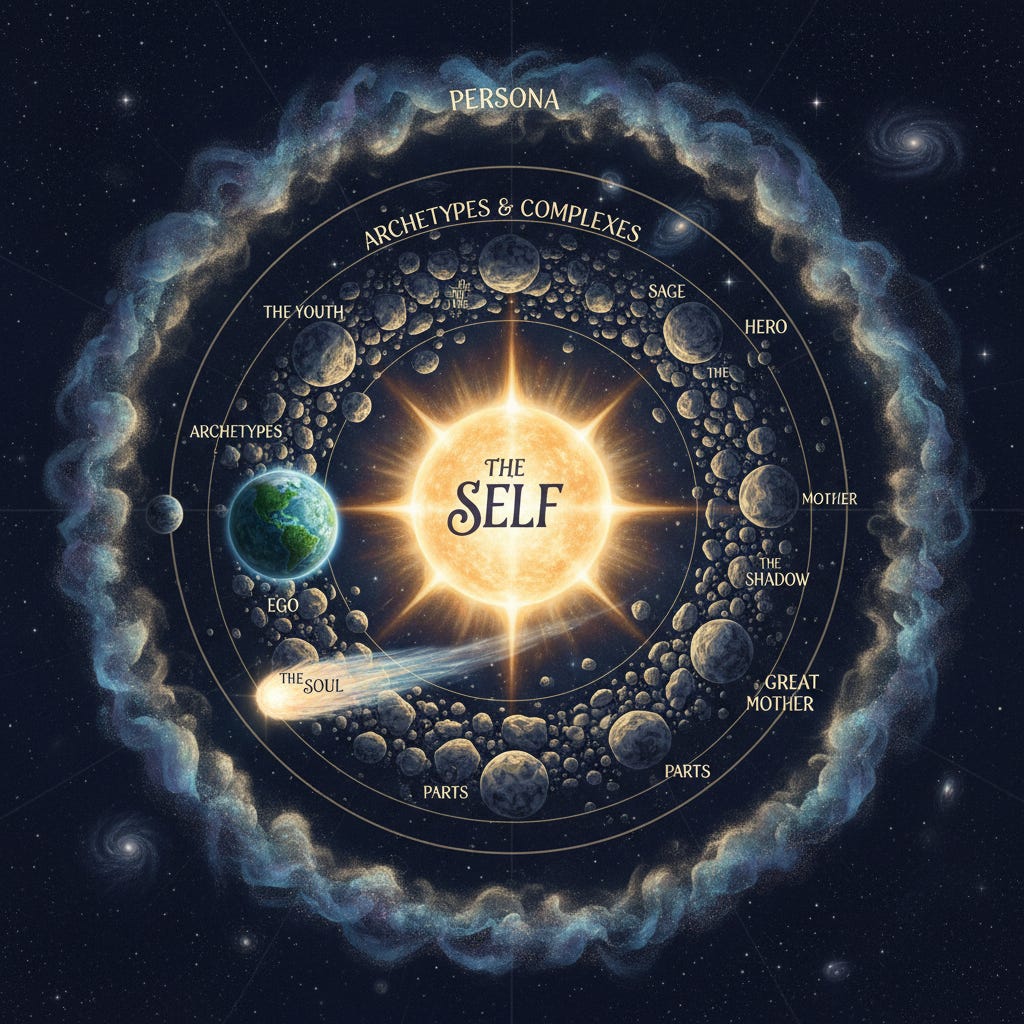
Anderson Todd speaking with John Vervaeke about the topic explained that Jung’s model might best be described as an inner solar system. Jung was important to Todd because, “he took seriously the realities of the soul.” Soul, then, must be defined as well, in order to understand what Jung meant by that term. Todd and Vervaeke in a Voices with Vervaeke episode clarify that Jung took a lot from Kant, and in turn, Plato. They suggest that the Jungian Archetypes might be analogous to the Platonic forms. We might say that categories structure our experience of knowing, and Jung was seeking an adequate set of categories to understand the unconscious.
The psyche, Vervaeke emphasises, was conceived by Jung differently from Freud’s hydraulic analogy of urges and repression. Rather than visualizing Jung’s conception as a cold mechanistic solar system, it should be seen as a warm living solar system. Jung emphasized the organic nature of it and said it was self-organizing and able to adapt to changing circumstances. Todd emphasizes that it is also intentional and has its own ideas about things. The psychodynamic model of Jung’s is a rejection of both the hydraulic mechanistic model, as well as a rejection of some pre-existing unity. The unity of individuation is a unity of work over a lifetime. While soul or atman are generally thought of as a unitive whole, describing an individual who is indivisible, Jung didn’t see it that way. He leaned instead towards a more dynamic sense of organic parts holding together under the systemic forces of the psyche like a solar system forms around a star.
Individuation, Todd explains, is the process of becoming more fully who you are over time. In the Jungian system you have multiple loci of agency in this process, different forces driving towards that end result. Different places in the psyche where work is going on. This includes the complexes, the ego, the shadow, the self, the persona and of course the soul.
Individuation
Individuation is a set of processes that change the relationship between the ego and the self. The shift from early life to mid life involves a shock or awakening. This startling insight is that the Ego does not run the show, and is not the centre of the psyche. Instead, the Self is the centre and the outcome. The Psyche is the entire solar system with all it’s parts, and the Self is like the sun at the centre of the system drawing it all together.
Like a Copernican revolution we all have on a personal level, this shift to see the centre as not the conscious ego, but something else, is both wonderfully freeing, but also deeply unsettling. The ego thought it was the centre of the show, and losing this status causes a crisis that can be “soul shattering” according to Todd.
A second shock comes when the ego realizes that not only is the Self at the centre and it is in orbit around the self, but that all the psychic elements, including itself, serve the self. The Ego is just one of these elements -- albeit an important one. Once this is realized and accepted, then the ego seems naturally to want to understand and have an encounter with the self, but that is usually not possible right away. Instead, Jung discovered, there was a process that was needed to get there. Typically you do shadow work first, considered the apprentice piece, then work with the anima/animus, what Todd calls the contra sexual soul image, then the archetypal forces, and then finally an encounter with the self. To stay with the solar system analogy, the self is the center star but also in an important way the organizer of the system, and it organizes through a spiritual or mystical process (phenomenology) that by its nature, can not be egoic or driven by consciousness alone. The ego must learn to trust the process.
The archetypes assist and function like those Kantian categories, or maybe like principles that guide the inner solar system. Jung’s late life work included an attempt to explain that there is an absolute epistemological limit to the arguments for or against God, but that nevertheless there are these god-like forces within us and treating them as god-like is the easiest way to progress. It doesn’t matter if there is a God or not, you still must have an encounter with the meaning-making part of yourself that is the locus of the sacred – that bright star the Self. That locus (the Self) communicates in symbolism and ritual, however, so to encounter the Self, you must explore the archetypes, the soul, and the complexes, as non-conscious parts of the self, and in combination all these elements are bigger and more powerful than the conscious sense of self the ego has.
The Role of Jungian Parts
The Persona, the Anima/Animus, and the Soul
The persona is the outward facing interface with the world (i.e. I’m a man and I show up this way), and the anima/animus is the inward facing interface (often as traits not selected for the persona). The anima/animus is the contra-sexual image of the soul, so for a man, the soul is like a goddess and for a woman the soul is like a god. The sexual part is because of the intimate nature of the connection the ego seeks with the self. The soul is the guide that helps the ego and self make that connection. And it is the interface, bridging rational thought with symbolic communication. It can be imagined as a psychopomp. Psychopomp literally means the ‘guide of souls’ and a psychopomp is often a creature, spirit, angel, demon, or deity. Here we get intriguing echoes of Schwartz’s comment about parts as spirits. The Psychopomp’s responsibility in our traditions is to escort newly deceased souls from earth to the afterlife. For Jung, the soul as psychopomp escorts newly awakened egos to the inner relationships, guiding the ego through the realm of the psyche. Jung also seemed to suggest that the soul (anima/animus) had the power to connect the ego to all the other parts, not just the Self.
Summary
So, according to Todd and Vervaeke’s understanding of Jung, the psyche is a living solar system that is self-organizing towards a greater sense of an integrated whole. It does this naturally, and a big part of middle and later life is situating the ego in a healthy relationship with all the other components of the self, where it is important (as the structure of consciousness), but not destabilized by hubris or inflation. And importantly, all the elements of the inner solar system are seen as organic, rather than simply material or spiritual. Jung was focused on developing an I/thou relationship between the ego and the self, rather than an I/it relationship.
Todd and Vervaeke agree that we are a dividual, not individuals. You can be, and are, divided, with dual aspects across the psyche, but the goal is to balance the system. Two important dualities are the shadow and the ego, and the persona and the anima-animus.
Additionally, many of the aspects of dreams and active imagination are trans-jective, meaning they point both to inner realities in the psyche and to outer events and conditions around the individual.
Brains Matter
Having been influenced more by neuroscience than philosophy over my life and having had my foundational training in psychology during the heyday of behaviourism, I have had to work hard to understand these models of the self outside of a materialistic view. In fact my influential professor, Dr. Paine, at the University of Victoria repeatedly said of Jung and Freud, “of course they just made this stuff up.” And for years I took that dismissal seriously.
Now I take a more pragmatic view of the brain as a highly interrelated organ that “has something to do with all our mental activity.” Genetics, is also a significant factor in someone’s identity, influencing many preferences from how spicy we like our food, to our sexual preferences, to our taste for conflict and stimulation.
Therefore, for me, self is a useful if imprecise term for a person’s overall identity as shaped by a particular brain, riding withing a particular set of genetic programs, shaped by a particular set of environmental factors, with some autonomous control over the body, but less that we might think. This whole solar system that Jung described is an emergent quality of the brain, ultimately dependent on it, but not necessarily equivalent to it.
Brain science has tremendous value, but at this pivotal time in my life finding a functional and useful model of personal growth is more important that finding the seat of the self with an MRI machine.
The Discoveries of Dick Schwartz
Larger Self or Sacred Self
In an article on the IFS institute website[6] Dr. Schwartz describes his discovery of a calm compassionate Self behind the parts of several of his clients. He writes, “When they were in that calm, compassionate state, I’d ask these clients what voice or part was present. They each gave a variation of the following reply: “that’s not a part like those other voices are. That’s more of who I really am. That’s my Self.” He goes on to describe working with another client and how his own inner parts raised fears and concerns until there was a breakthrough in which the client’s own compassionate self was revealed. It is a deeply warming and encouraging account of Dr. Schwartz’ persistence and how his own centering in “Self” with a capital S creates a therapeutic trust. Dr. Schwartz writes that over the years he has, “come to trust the healing power of what I’ll call the Self in clients and in myself. When there’s a critical mass of Self in a therapy office, healing just happens.”
In an interview with Tami Simmon for Sounds True, Dr. Schwartz explained, “… that’s the way I’ve come to see Self, that it isn’t individualized; it’s not this little particle inside of us; but that actually, it is a field or a wave; and that when you enter that (and mystics have entered that for years; people can enter that these days through psychedelics often or meditating) you lose the boundaries around your individual body actually a lot of the time, and enter that field, you do feel this enormous connectedness and sense that we aren’t really different, we aren’t disconnected in the way we have been. And that then if you can bring that awareness, that C word, connectedness, back into your individual, body-bound Self (which is a lot of the impact I think of psychedelics now) it really changes many things in people’s lives, just that knowledge that we’re not these isolated little units.”
In the original article mentioned above, Dr. Schwartz says it another way, “Though they used different words, all the esoteric traditions within the major religions – Buddhism, Hinduism, Christianity, Judaism, Islam – emphasized their same core belief: we are sparks of the eternal flame, manifestations of the absolute ground of being. It turns out that the divine within – what the Christians call the soul or Christ Consciousness, Buddhists call Buddha Nature, the Hindus Atman, the Taoists Tao, the Sufis the Beloved, the Quakers the Inner Light – often doesn’t take years of meditative practice to access because it exists in all of us, just below the surface of our extreme parts. Once they agree to separate from us, we suddenly have access to who we really are.”
When Dr. Schwartz goes on to explain the distractions and provocations that keep us from meeting people with the right mindset so that we are not drawn into competition, defensiveness, -- well, I feel a deep relating. I often want to be able to cut through the provocative things people are saying to see their true intention, pain, heart, self. But I get stuck in my own reactions and triggers. I agree with Dr. Schwartz that I need a way to stay grounded and openhearted. He says we can tap into something at the very core of our being that provides a “deep keel for our sailboat in the storm,” This core, when we are grounded in it, keeps us centered in what he calls the Self with a capital S. He describes it as, “… the deep ground of our being…” a term popularized by Tillich, and that language evokes the idea of, well, God.
Is Schwartz saying that the self at the core of our being is God? Perhaps not as a theist might conceive it, but I think he is suggesting something along those lines. For Schwartz (and perhaps Jung too) the Self with a capital S is a field in which we all participate and that connects all of us. Less an individual being, and more a universal presence manifesting or embodying the 8 Cs of the theory.
The Contribution of Dynamic Systems Theory
Locke’s Essay Concerning Human Understanding (1689) presented “self” as a continuity of consciousness, distinct from the more theological term, soul. Locke’s essential idea has been reinvigorated by Evan Thompson and others who work in an area of psychology and philosophy becoming known as “Dynamic Systems Theory.”
Thompson theorizes that the self is a changing process, not a static thing, and this idea resonates with Jung’s idea of the self as an organic set of relationships that change over our life. When we are awake, we identify with our body, but if we let our mind wander, much as Descartes did in his famous “I think therefore I am” experiment, we sense ourselves as somehow separate from the body. This separate self, in the world of Dynamic Systems Theory, can be projected into the remembered past (sometimes leading to depression) or anticipated future (sometimes triggering our background alarm [7], or anxiety). This sense of self can also escape the boundedness of the body when we dream. The self in dreams can have experiences with a bodily sense, even when the body is asleep. In meditation we can observe whatever images or thoughts arise and how we tend to identify with them, “these are my thoughts,” -- the “my” being the sense of self. The self really does seem separate from the thoughts or the body.
Contemplative traditions say that we can learn to let go of the self, so that when we die, we can witness the self’s dissolution with equanimity. After the above exploration I would say that maybe these traditions see the self as more similar to the ego. The traditions argue that there is a reality that is different from this self (the ego) that is somehow connected to something higher or deeper, or they teach that the self (ego) is an illusion that forms the vehicle for suffering. In this sense, a self (ego) is required for suffering to occur.
Neuroscience generally rejects the idea of a single, unified “self” residing in some fixed set of structures within the brain. Instead, research suggests that the sense of self is an emergent property of multiple interacting brain networks. This nicely lines up with the basic tenants of Dynamic Systems Theory once self is seen as the “ego-self.”
What Dynamic Systems Theory tied together for me is this idea that suffering resides in the sense of self the ego has. And if Jung and Schwartz are right, that sense of self is only part of the picture. There is a much bigger self beyond that ego-self and that bigger sense has been known by mystics for millennium. That bigger sense of self may simply be a connection to the divine as religions have concluded, or it may be an internal experience of something more personal, a field that every human has access to, that exists beyond the suffering and trauma experienced by the ego.
Using the IFST model, the ego can be seen as a major part in the inner family. And like all parts, the ego has a sense of self, is in fact, a self-contained entity within us. In this sense each part participates in the field of self.
Scientific, Buddhist and Christian Views
I have held a generally emergentist view of mind since my studies in basic psychology at UVIC, over 30 years ago. The most compelling argument for me of the malleability of the mind came from people with brain damage. I was impressed with accounts of personality changes resulting from lobotomies, strokes, and other injuries. I had witnessed profound changes in emotional stability and social acuity during my time working in senior’s care homes as a young man. People changed when their brain was damaged, diseased, or influenced by medications or drugs.
Recent research has identified three networks in the brain that may be responsible for giving rise to a sense of self or mind. These are the Default Mode Network[8], the Salience Network[9], and the Executive Control Network.[10]
These networks don’t correspond neatly to a “a sense of self” but they do show that the brain operates in modular, context-dependent ways, which could align with the idea of a self as an emergent entity as Dynamic Systems Theory posits.
The idea that the ego sense of self is what suffers, especially regarding emotional or psychological suffering, can now be conceptualized beyond a specific religious context. Contemporary self-help practitioners often recommend meditation and other ego flattening practices in which the practitioner seeks to become aware of the sense of self, and the self’s role in illness and suffering. What I am suggesting is that this be clarified in light of Jung and Schwartz as not so much THE self, but merely the ego’s sense of self. And by extension, the job is not to flatten or anesthetize the ego, but rather to bring it into a relationship with the larger self. Each part’s sense of self is a real sense.
Buddhism, broadly speaking, roots suffering in ignorance about the true nature of existence, suggesting that the feeling we have of independence and individuality is the source of suffering. Christianity takes an almost opposite view, that we do not believe enough in the reality of “the other,” including the ultimate other, God. The “I Am” of both Jewish and Christian conceptions of God, exalts this sense of being an “I” to the highest level.
Buddhism sees the ego as an error or misperception, and Christianity sees the ego as a source of sin. Augustine, for example, said the root of all sin was turning away from God, the I Am. We might say this is a turning away from the ultimate consciousness in favour of clinging to our limited consciousness. Connection both to other selves, and to what is (Reality-God) has emerged in recent years as solution to the dis-ease we feel. Buddhism sees freedom in ceasing to believe in a separate self. Many traditions in Christianity see freedom in submitting our small self to a higher self of God. In both cases, excessive attachment to one’s own desires, identity, preferences, and perspective, is the mechanism of concern.
Christianity’s Conception of the True and False Self
Dr. Ilia Delio, Catholic scholar of science and religion, tells the story of discovering Thomas Merton while “standing in the middle of the lab one day, procrastinating.” She was working as a doctoral student in pharmacology at New Jersey Medical School, and saw a book review about Merton’s biography. She continued with her studies in neuropharmacology and neuromuscular disease, but shortly after receiving her doctorate, entered a monastery in search of what Merton described. What followed was a 40-year project of understanding and teaching the intersection between science and religion, including recently the evolutionary significance of Artificial Intelligence.
Dr. Delio wrote in January of 2017, “To pray, in the monastic sense, is to enter into dialogue with God, heart to heart. [beyond words] Prayer is that deep silent encounter in which the innermost center of our being continuously stretches toward that which is not yet seen or fully known; yet, it is a type of deep knowing that we belong to God. Merton drew on the integral relationship between God and the human person, as if defining the double helix of divinity and humanity: our lives are intertwined with God’s life. “God utters me like a partial thought of Himself,” he wrote. Hence the only path to true happiness is prayer, and prayer begins with self-discovery.”
Our lives are intertwined with God’s life like a double helix. This image helps make sense of Merton’s idea of the true self. For me, it gives an image of the true self not as a fixed established entity living in the hidden depths of our being, but as an emerging and correcting strand, mirroring the divine around which it continually twists. In a metaphorical and metaphysical sense, as the two strands are brought together, each moving forward as the spiral progresses, a life is defined. The true self is that self which both shows us God and shows us what is not true self. The code is a reference point for both personal growth and maturation, for “coming out right” as the old shaker song put it, while also pointing to the evolutionary reality of existence.
Delio quotes Merton, “Every one of us is shadowed by an illusory person: a false self. This is the man that I want myself to be, but who cannot exist, because God does not know anything about him. … My false and private self is the one who wants to exist outside the reach of God’s will and God’s love — outside of reality and outside of life. And such a life cannot help but be an illusion. … The secret of my identity is hidden in the love and mercy of God. … Therefore I cannot hope to find myself anywhere except in him. … Therefore there is only one problem on which all my existence, my peace and my happiness depend: to discover myself in discovering God. If I find Him, I will find myself, and if I find my true self I will find him (pp. 34-36).”[11]
I had read that passage in New Seeds of Contemplation but had been distracted by the “God talk” which I found imprecise and often simply too broad to be helpful. But reading it as abbreviated by Delio I heard a new insight. The false self is a construction we work on based on what we think will fit the demands of the world around us – could this be the ego attempting to be perfect by excluding shadow elements? From the IFST perspective, it is the development of parts, often unconscious to the ego. They serve a purpose – survival, and can include roles, social skills, protective parts and other psychological defense mechanisms.
The true self, on the other hand, is the self that unfolds beside the god strand, not separate from it, and containing important corrective codes. It is not God, per se, but rather a mirror of divine presence, acting like a sun for our internal solar system. It creates the gravity and structure the other elements of the psyche need to function.
I accept the proposition of Jung and others that there are in this inner solar system things like archetypes, similar to Kantian categories or platonic forms, that give structure to the unfolding and help shape the mature psyche system. Delio’s idea of the guiding structure in us, part divine and part human, gets very close to the Schwartz’ idea of the Self.
Therefore I am comfortable saying that the Self with a capital S of IFST lines up nicely with the Self of Jungian conception, and the “True Self” of Delio/Merton. It is a field more than a material. Like a field it is less solid and fixed and more dynamic than what many of us think of as self, but it is also evolving and alive, which gives hope to the idea of self-development. The human project, then, whether we like it or not, is to survive through the development of parts that then can be harmonized into an internal solar system around this unifying field.
Interestingly, the True Self is not emergent from the other elements, but instead is the organizing system itself, responsive to the environment, and our own inner growth. The places we get stuck are the places that the emergent true self catches, as the creation of a part, the repression of a shadow element, or some other dead end. Like a potter or sculptor, or even engineer, we can learn to make ourselves, from making these versions of ourselves. The person I make today is more artistic or more structurally sound that the person I made when I was 10 years old. When we “reinvent” ourselves it is because the self we made was not keeping up with the curve of the divine DNA. We had stalled or deviated from a healthy emergence.
The work of the Coach
“I want to unfold. Let no place in me hold itself closed, for where I am closed, I am false. I want to stay clear in your sight.” - The Book of Hours, Rainer Maria Rilke (translated by Anita Barrows & Joanna Macy) I, 59:
In another conversation[12], John Vervaeke touched on Jung’s theory of healing saying that “the self is the most basic archetype, the archetype of archetypes. It’s a movement essentially toward unity and wholeness and Jung called that movement individuation. The ego is the archetype for consciousness, and the self is the archetype for the whole of the psyche.
In such a complicated and largely unconscious system, the role of the Jungian Coach is to help the ego come to see it’s place in the larger system, and trust the Self to heal the parts and evolve into a greater unified whole. The ego is very important in that it is the archetype of consciousness, and becoming conscious of the unconscious aspects of the psyche is an important part of individuation.
The contribution of IFST
The important contribution of IFST that resonates deeply with me is the technique of dialogue with parts. This treatment of inner entities as persons in their own right, feels respectful and relational. How these parts map to the parts Jung identified (anima/animus, persona’s, archetypes, complexes, constellations, etc) is not readily clear. My suspicion is that they can be seen as equivalent to complexes, personas, and the anima/animus.
As I move through this process, I will take the “C focused” field of Self and meet all the parts as selves, participating in that field of evolving order.
[1] The Spirituality of Internal Family Systems, A Practice-Based Journey to Your Sacred Self with IFS Founder Richard Schwartz, PhD was promoted to run in October 2025, at the time of this writing (Dec 2025) the program is no longer listed on the Sounds True website. AI explains, “The course The Spirituality of Internal Family Systems included a live Q&A session with Dr. Richard Schwartz on October 21, 2025, indicating that the course was active in October 2025. The program was structured over ten weeks, with on-demand video sessions and the live event serving as a key component.”
[2] 37:42 of After Socrates Episode 3 – Dialectic into Dia-logos.
[3] Pg 22 of The Internal Family Systems Workbook, a guide to discover your self and heal your parts. By Richard C. Schwartz, 2024, Center for Self Leadership PC, Sounds True.
[4] https://socialsci.libretexts.org/Bookshelves/Sociology/Introduction_to_Sociology/Sociology_(Boundless)/04:_The_Role_of_Socialization/4.02:_The_Self_and_Socialization/4.2C:_Psychological_Approaches_to_the_Self
[6] https://ifs-institute.com/resources/articles/larger-self
[7] Dr. Russell Kennedy uses the term “alarm” instead of anxiety to emphasis the sense we have in the body, not just the thoughts we have about things.
[8] Associated with self-referential thinking, autobiographical memory, and mind-wandering. Some researchers link this to the “narrative self” (the story we tell about ourselves).
[9] Helps determine what internal or external stimuli are most relevant to us at any given moment, possibly influencing which “self” or mode is dominant.
[10] Involved in decision-making, impulse control, and future planning—often associated with the “wise” or rational self.
[11] https://www.ncronline.org/blogs/ncr-today/discovering-true-self-god-mertons-guidance
[12] 17:10